
Dave Takes Off
Out of the Verizon Fire into the Nursing Frying Pan

This week was my husband Dave’s last day at Verizon as a field tech.
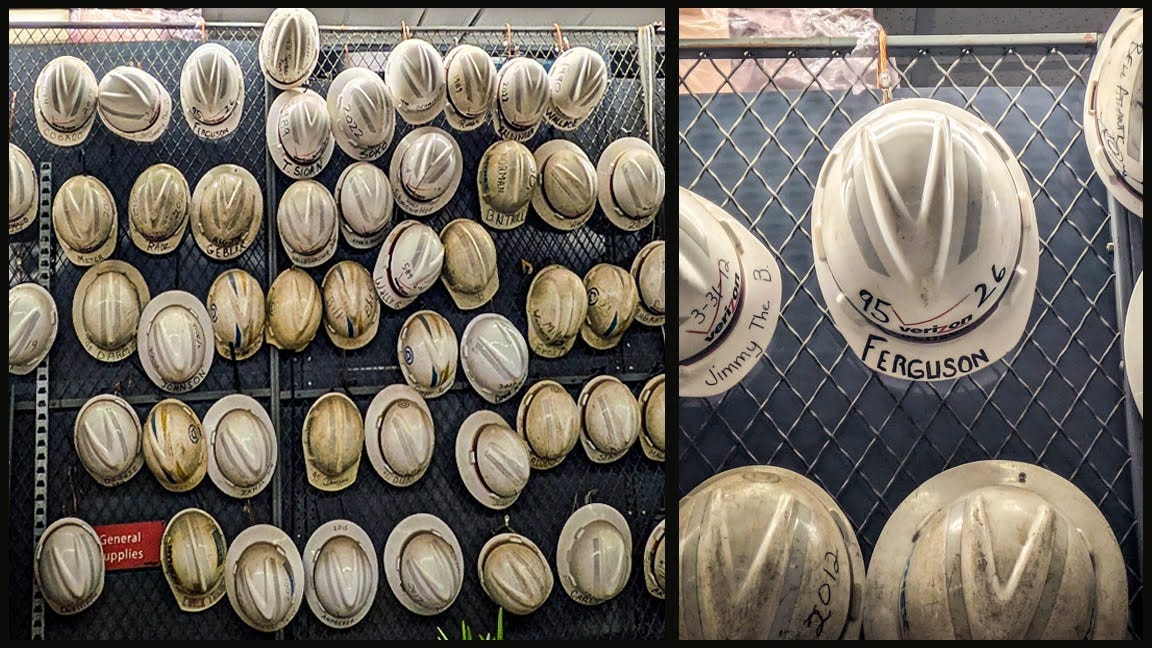
At the Dyke Road yard, where he’s been based on and off for nearly thirty years, there’s a custom: when someone retires, their hard hat gets hung on the fence. Dave’s is there now—his name written across the front, the plastic dulled from decades of weather and work.
Technically, Dave is retiring. Really, he’s changing careers. True retirement is still a long way off. What this moment marks is he gets to have the career he wanted, to be a nurse.
He earned his RN and BS years ago through Verizon’s education program, back when our son Sam was still a toddler. He could have changed careers then, but we couldn’t afford it. After multiple miscarriages and, eventually, advanced maternal age, we decided to adopt, something Verizon’s benefits helped make possible, too. Staying for thirty years gave Dave a pension, and an opportunity to do a job he wants to do. Last September, he started working part time at Jericho Road, a neighborhood health clinic on the West Side that serves immigrant families.
His last day of work at Verizon was snowy and stormy, the kind of weather that edits memory into a montage. In Buffalo, we tend to get dreamy in winter; we stack our memories the way snow drifts outside our windows. It reminds me of the same kind of week, twenty-four years ago, when Dave and I were just dating and he was climbing telephone poles. For a while, he was assigned to work behind my grandmother’s house on Potter Road, where I was living at the time. I drove by more than once to see him braced against the pole, boots planted on the steel gaffs, shoulders set into the blowing snow, wondering if I should bring him a sandwich, always deciding I’d look stupid standing there with one, more stupid than just circling the block again.
This kind of loitering around telephone poles wasn’t new to me. The person who had introduced Dave and me was my uncle’s friend Orville. Before working with Dave at Verizon, Orville had worked for the cable company when I was a teenager.
Orville was handsome in a Tom Selleck kind of way, mustached, his face weathered from working outside, fit from climbing poles. Whenever he was working in the neighborhood, one of the girls would call and we’d all rush outside, trying to look casual.
I’d yell into the kitchen to my grandmother, “That was Darla. Orville’s out front.”
My aunt and I would hustle toward the door, swiping on eye shadow that cracked in the humidity of our creases. Orville was older than her, way out of my league, but out I went. My grandmother would shout I remember freezing in the doorway, imagining myself holding a sweaty glass of Tang, convinced that offering food would make me look even more suspicious than pretending to watch for traffic on the parking strip. The door slammed behind me. Two decades later, I circled the block again to gawk at Dave, edging along the parking strip, sandwich-less.
To my grandparents, Orville had what counted as a good job—meaning union. In the Reagan years, with the steel plant closing and bad jobs everywhere, steady work with a solvent company, healthcare, and a pension was no small thing. Seeing Dave on that pole in the snow gave me the same teenage-girl chill, rugged, tough, like some Marlboro man fantasy.
We come from and are a working-class family. By that I don’t mean some MAGA distortion, stripped of solidarity and fed on resentment and outrage, voting against self interest. I mean unionized, jobs that require people to believe in the strength of the collective.
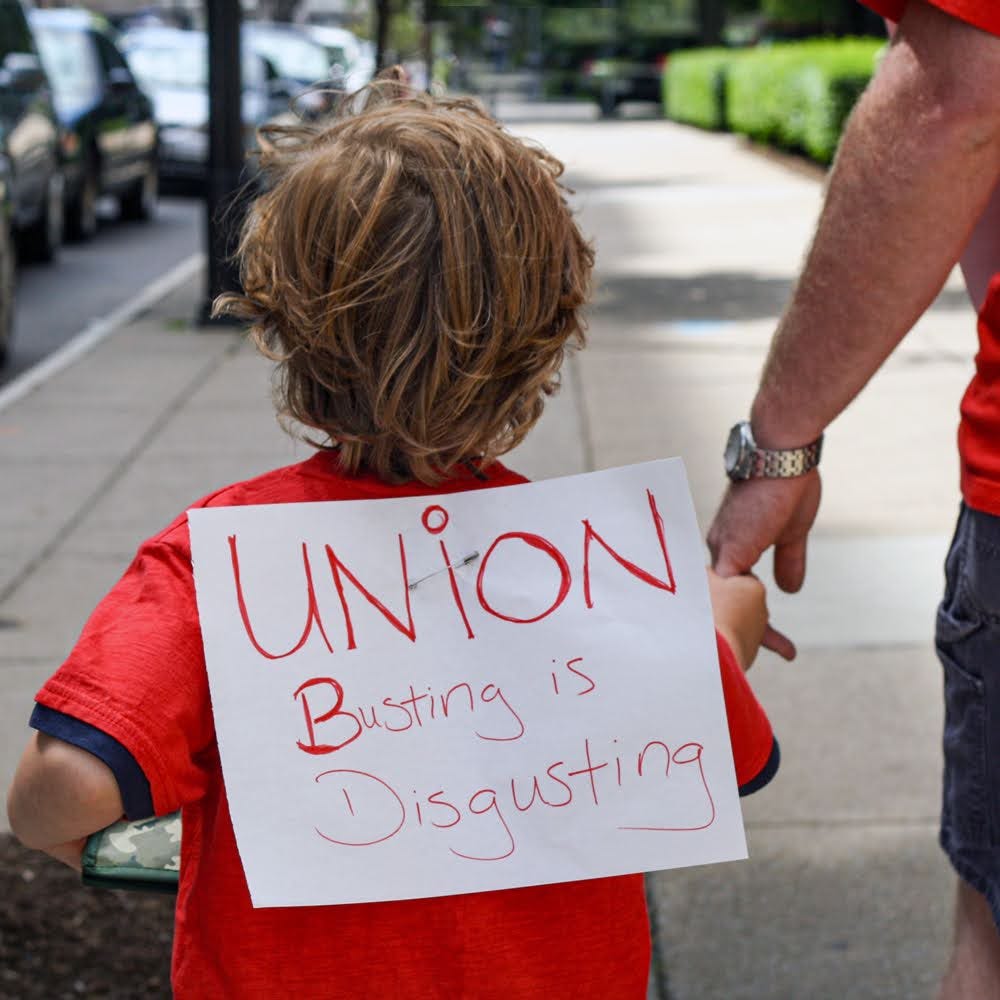
With Dave that kind of solidarity isn’t just in where he works but who he is. Being with someone who wasn’t driven by personal ambition, materialism, careerism, but by responsibility and care for his family, healed something in me and made our dreams as a family possible.
When Sam wanted to be a Merchant Mariner, a dream Dave once wished for himself, but couldn’t without family money or support behind him. Dave didn’t shrink Sam’s world to keep him close with anxiety. He took him to SUNY Maritime again and again in shitty motels to make it a reality.
I told Cal that this is part of why his dad liked me when we met—that I’d lived outside Buffalo, had creative aspirations, and wanted more than life had allotted me. We chose transracial adoption to make our lives bigger, bringing new community and culture into our family.
I will never forget being at the child’s Kwanzaa, in a room full of Black families, Dave the only white man there. One of the dads from Sam’s school leaned over and said, “A lot of white guys look good on paper, but it’s all paper. You’re here.”
This is the truth of Dave. He wants the world for us. This summer we were on the dock as Sam stepped out of the ship’s Ro-Ro (Roll on / Roll off) that had returned from the Arctic Circle.
We haven’t had an easy ride—cars driven until they end up in the junkyard, our house ever getting fixed up, more vacations canceled than taken. We both carry that by hook-or-by-crook, loud aggravation of our working-class upbringings. By most measures, we should be divorced and bitter by now, but hours of therapy, a 401K and many sandwiches later, we are looking at this juncture happier than we have ever been.
And now Dave finally gets the thing he’s always made possible for the rest of us: a bigger world—one he’s stepping into every day at Jericho Road.


I love the way you write Lesa. So much tenderness in the words you string together while at the same time you capture a certain edginess that is very appealing and authentic. Good on your man!!!! I really respect that he’s made this new chapter his own. What is time anyway but what keeps us moving until we get to our destination(s) right??
Best to you all in 2026!♥️
Thank you so much Danyel. I love how we have circled back. Means a lot to me.